

Subordinating conjunctions are words like "because," "although," "since," "while," and "if" that connect a dependent clause to an independent clause, showing how the two ideas relate: cause and effect, contrast, condition, or time. "She stayed home because it was raining" uses "because" to link the reason (dependent clause) to the main action (independent clause).
Writing that flows naturally almost always comes down to one thing: how well your ideas connect. You might have strong vocabulary and solid arguments, but if your sentences feel choppy or disconnected, the overall impact weakens. This is where subordinating conjunctions quietly do some of the most important work in English.
They help you link ideas, show relationships, and add depth to your sentences. Once you understand how to use them properly, your writing immediately becomes more polished and easier to follow.
This guide will take you from the basics to advanced usage, with clear explanations and plenty of examples you can actually use in your writing.
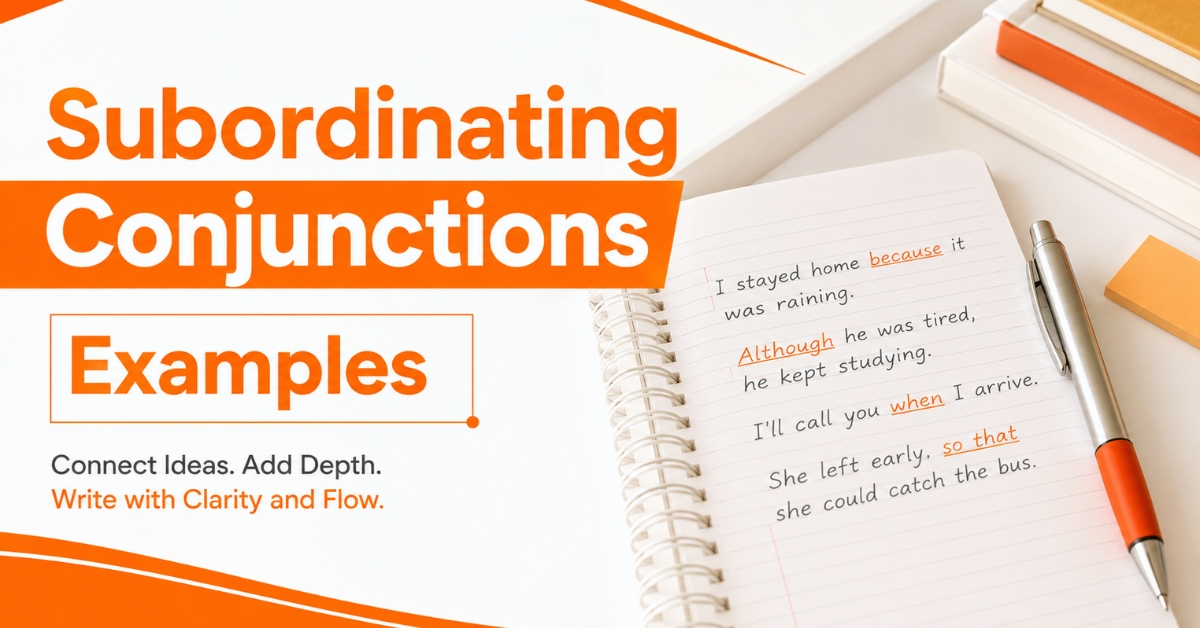
What Are Subordinating Conjunctions?
A subordinating conjunction is a word that connects a dependent clause to an independent clause, showing a specific relationship between the two.
In simple terms, it helps explain how one idea relates to another.
Common subordinating conjunctions include:
- because
- although
- since
- while
- if
- when
- unless
- before
- after
- even though
These words introduce a clause that cannot stand alone as a complete sentence.
How Independent and Dependent Clauses Work Together
Before going further, you need to understand this distinction clearly.
Independent Clause:
A complete sentence that can stand alone.
Example: She finished her assignment.
Dependent Clause:
An incomplete sentence that needs more information.
Example: because she had a deadline
When you combine them using a subordinating conjunction, you get a complete and meaningful sentence:
She finished her assignment because she had a deadline.
Why Subordinating Conjunctions Matter
Subordinating conjunctions are not just grammar tools. They shape how your ideas are understood.
They Add Clarity
They show cause, contrast, condition, time, and more.
They Improve Flow
Instead of short, disconnected sentences, your writing becomes smooth and logical.
They Show Relationships Between Ideas
Readers can clearly see why something happened, when it happened, or under what condition.
They Strengthen Academic Writing
Essays become more structured and analytical rather than basic and descriptive.
Types of Subordinating Conjunctions (With Examples)
To use them effectively, it helps to group them based on the relationship they express.
1. Cause and Effect
These explain why something happens.
Common words: because, since, as
Examples:
- She stayed home because she was feeling unwell.
- Since it was raining, the match was canceled.
- As he had already studied, he felt confident.
2. Contrast and Concession
These show a contrast between ideas.
Common words: although, though, even though, whereas
Examples:
- Although he was tired, he continued working.
- Even though the task was difficult, she completed it.
- Whereas some prefer online learning, others value classroom interaction.
3. Condition
These express conditions under which something happens.
Common words: if, unless, provided that
Examples:
- If you study regularly, you will improve.
- Unless you try, you will never know.
- You can go out provided that you finish your work.
4. Time
These indicate when something happens.
Common words: when, while, before, after, until
Examples:
- She called me when she arrived.
- While he was studying, his phone rang.
- Finish your homework before you watch TV.
5. Purpose
These show the intention behind an action.
Common words: so that, in order that
Examples:
- He whispered so that no one could hear him.
- She saved money in order that she could travel.
6. Result
These indicate outcomes.
Common words: so…that
Examples:
- The movie was so interesting that we watched it twice.
- He was so tired that he fell asleep immediately.
7. Place
These show locations.
Common words: where, wherever
Examples:
- Sit wherever you feel comfortable.
- I will follow you where you go.
Sentence Structure Rules You Must Know
Subordinating conjunctions affect punctuation and sentence structure.
Rule 1: Dependent Clause First → Use a Comma
Example:
Because she was late, she missed the meeting.
Rule 2: Independent Clause First → No Comma
Example:
She missed the meeting because she was late.
Rule 3: Avoid Sentence Fragments
Incorrect:
Because he was tired.
Correct:
Because he was tired, he went to bed early.
Common Mistakes and How to Avoid Them
Even though subordinating conjunctions are simple to use, small mistakes can affect the clarity and flow of your writing. Here are the most common issues to watch out for and how to fix them.
1. Using a Dependent Clause Alone
This creates incomplete sentences.
2. Overusing One Conjunction
Repeating “because” too often makes writing dull.
3. Misplacing Clauses
Incorrect placement can confuse meaning.
4. Mixing Conjunction Types
Using the wrong conjunction changes meaning.
Advanced Usage Tips
Once you’re comfortable with the basics, subordinating conjunctions become more than just connectors, they turn into tools for shaping clarity, rhythm, and emphasis in your writing.
Vary Your Sentence Structure
Avoid starting every sentence the same way. Sometimes begin with the dependent clause, other times with the main clause. This variation keeps your writing natural and engaging rather than predictable.
Combine Ideas for Better Flow
Instead of writing short, disconnected sentences, use subordinating conjunctions to link related ideas. This not only improves readability but also helps your writing feel more cohesive and polished.
Use Structure to Create Emphasis
Place the most important idea in the independent clause, since it carries the main weight of the sentence. The dependent clause should support it by adding context, reason, or contrast.
With these small adjustments, your writing starts to feel more intentional, controlled, and effective rather than basic or repetitive.
Sentence Improvement Examples
Let’s look at how subordinating conjunctions can turn basic, disconnected sentences into smoother, more meaningful ones.
Basic:
He was tired. He kept working.
Improved:
Although he was tired, he kept working.
Here, the conjunction adds contrast and makes the relationship between ideas clear.
Basic:
She studied hard. She wanted to pass.
Improved:
She studied hard because she wanted to pass.
In this case, the conjunction shows cause and effect, making the sentence more logical and connected.
Basic:
It was raining. We went outside.
Improved:
Although it was raining, we went outside.
Basic:
He didn’t study. He failed the test.
Improved:
Because he didn’t study, he failed the test.
Basic:
Finish your homework. You can watch TV.
Improved:
You can watch TV after you finish your homework.
Basic:
She was nervous. She gave a great presentation.
Improved:
Even though she was nervous, she gave a great presentation.
Basic:
Call me. You arrive.
Improved:
Call me when you arrive.
Basic:
He saved money. He wanted to buy a car.
Improved:
He saved money so that he could buy a car.
Practice Section: Apply What You’ve Learned
Now it’s your turn. Try combining the following sentences using appropriate subordinating conjunctions. Focus on making the relationship between ideas clear and natural.
Combine these:
- It was raining. We went outside.
- She was nervous. She gave a great presentation.
- Finish your work. You can relax.
Take a moment to write your own versions before checking the examples.
Possible Answers:
- Although it was raining, we went outside.
- Even though she was nervous, she gave a great presentation.
- Finish your work before you relax.
Notice how each sentence now clearly shows contrast or time. This is what makes your writing feel more connected and complete.
To improve clarity and avoid repetition in your writing, exploring another word for common terms can help you expand your vocabulary and express ideas more effectively.
Tips for Academic and Essay Writing
Subordinating conjunctions play a key role in making your academic writing clear, logical, and well-structured. They help you move beyond simple statements and show how your ideas connect, which is exactly what strong essays require.
Here’s how to use them effectively:
- Explain your arguments more clearly by showing why something is true
- Highlight cause and effect so your reasoning feels logical and supported
- Link evidence to conclusions instead of presenting them as separate points
- Improve flow and readability by avoiding short, disconnected sentences
Example:
Instead of:
The results were surprising. The data was limited.
Write:
Although the data was limited, the results were surprising.
This small change adds contrast and makes the relationship between ideas clear. In academic writing, this kind of connection is what turns basic sentences into well-developed analysis.
From a grammar and language perspective, exploring double entendre examples and how to use them in essays can help you understand how meaning can shift through structure and word choice.
Write Better, Connect Smarter with WriteEssayToday
With practice, you’ll not only avoid common mistakes but also develop a writing style that feels natural, confident, and engaging. Strong writing isn’t just about what you say, it’s about how clearly and effectively you connect your ideas. Subordinating conjunctions are one of those small tools that make a big difference, helping your work sound more structured, logical, and academically strong.
If you’re aiming to improve your writing or need expert support with essays, assignments, or academic tasks, WriteEssayToday is here to help. Our Essay Writing Service is designed to support you with well-structured, high-quality academic content that meets your requirements. With the right guidance, you can turn good writing into great results.
Write smarter, score higher, and let your ideas come across exactly the way they should.