

In essay writing, double entendre can make arguments more engaging, analysis more insightful, and storytelling more memorable. It helps writers add subtle humor, irony, or layered meaning without losing clarity. However, many students find it difficult to recognize or use double entendre effectively in academic writing.
This guide explains everything you need to know about double entendre, including its meaning, types, examples, literary significance, and practical ways to use it in essays. Whether you are working on a literary analysis, persuasive essay, satire, or creative assignment, learning how to use double entendre can help elevate your writing style and critical thinking skills.
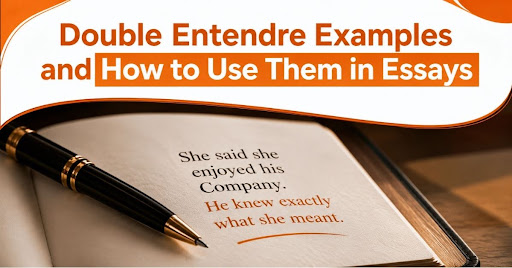
What Is a Double Entendre?
A double entendre is a phrase, sentence, or expression that has two meanings. Usually, one meaning is straightforward and innocent, while the second meaning is indirect, humorous, ironic, or suggestive.
The term comes from French and literally means “double meaning.”
A double entendre relies on:
- Wordplay
- Ambiguity
- Context
- Tone
- Cultural understanding
The second meaning may be:
- Humorous
- Sarcastic
- Romantic
- Satirical
- Critical
- Suggestive
Not all double entendres are inappropriate. Many are completely harmless and simply clever uses of language.
Simple Definition
A double entendre is a sentence or phrase that can be interpreted in two different ways.
Example:
“Marriage is a fine institution, but I’m not ready for an institution.”
The first “institution” refers to marriage, while the second jokingly suggests a mental institution.
This creates humor through layered meaning.
Origins of Double Entendre
Double entendre has existed for centuries in literature and speech. Ancient writers used hidden meanings to avoid censorship, criticize society, or entertain audiences subtly.
Famous writers known for using double entendre include:
- William Shakespeare
- Geoffrey Chaucer
- Oscar Wilde
- Mark Twain
In earlier periods, writers often used double entendre because direct criticism of political leaders or open discussion of sensitive topics was dangerous or socially unacceptable.
Today, double entendre appears in:
- Literature
- Essays
- Speeches
- Advertising
- Movies
- Television
- Songs
- Comedy
Characteristics of Double Entendre
A double entendre usually contains these features:
1. Dual Meaning
The phrase has two interpretations.
2. Ambiguity
Readers may initially understand only the obvious meaning.
3. Cleverness
The hidden meaning creates surprise or amusement.
4. Context Dependence
The second meaning often depends on cultural or situational understanding.
5. Figurative Language
It commonly uses puns, irony, symbolism, or metaphor.
Types of Double Entendre
Understanding the different types helps writers use them more effectively in essays.
1. Humorous Double Entendre
This type creates comedy through wordplay.
Example:
“I used to be a banker but I lost interest.”
“Interest” refers both to motivation and bank interest rates.
Purpose:
- Entertain readers
- Add wit
- Make writing memorable
2. Romantic or Suggestive Double Entendre
This version contains subtle romantic or flirtatious meaning.
Example:
“Are you free tonight?”
It may literally ask about availability while also implying romantic interest.
Purpose:
- Create tension
- Add sophistication
- Introduce emotional subtext
In academic essays, suggestive double entendre should be used carefully and only when relevant to literary analysis or rhetorical discussion.
3. Satirical Double Entendre
Writers use this form to criticize society, politics, or institutions indirectly.
Example:
“The politician promised transparency while hiding everything important.”
“Transparency” becomes ironic because the hidden meaning exposes dishonesty.
Purpose:
- Criticize indirectly
- Expose hypocrisy
- Strengthen satire
4. Literary Double Entendre
Common in poetry and novels, literary double entendre adds symbolic depth.
Example:
“The crown weighs heavily.”
The crown may represent:
- A literal crown
- Responsibility and leadership
Purpose:
- Add symbolism
- Encourage interpretation
- Deepen themes
Difference Between Double Entendre and Pun
Many students confuse these two devices.
| Double Entendre | Pun |
|---|---|
| Has two meanings | Uses similar sounds or meanings |
| Often subtle | Usually direct |
| Can contain irony or symbolism | Mostly humorous |
| Requires interpretation | Easier to notice |
Pun Example:
“Time flies like an arrow; fruit flies like a banana.”
Double Entendre Example:
“She finally found her voice.”
This may mean:
- She literally began speaking confidently
- She discovered personal identity and empowerment
Famous Double Entendre Examples in Literature
Many classic literary works use double entendre to create complexity.
Shakespeare’s Use of Double Entendre
William Shakespeare frequently used double entendre in his plays.
Example from Romeo and Juliet:
“Ask for me tomorrow, and you shall find me a grave man.”
“Grave” means:
- Serious
- Dead in a grave
This line becomes emotionally powerful because it foreshadows death.
Oscar Wilde’s Wit
Oscar Wilde mastered clever double meanings.
Example:
“I can resist everything except temptation.”
The humor comes from contradiction and irony.
Chaucer’s Hidden Meanings
Geoffrey Chaucer used layered language in The Canterbury Tales to critique medieval society subtly.
His double entendres often contained social criticism disguised as humor.
Double Entendre in Modern Media
Double entendre is still widely used today.
In Advertising
Advertisers use double meanings to make slogans memorable.
Example:
“Nothing runs like a Deere.”
This slogan by John Deere suggests:
- Machines run efficiently
- Deer animals run naturally
In Movies and TV Shows
Comedy writers use double entendre to entertain audiences without explicit statements.
Animated films especially use layered jokes that adults understand differently than children.
In Songs
Many song lyrics contain hidden emotional or symbolic meanings.
Example:
Songs about “home” may refer to:
- A physical place
- Emotional comfort or belonging
Why Writers Use Double Entendre
Double entendre serves several purposes in writing.
1. Adds Depth
Multiple meanings encourage readers to think critically.
2. Creates Humor
Unexpected meanings often make readers laugh.
3. Encourages Reader Engagement
Readers become more involved when interpreting hidden meanings.
4. Enhances Creativity
It demonstrates sophisticated language skills.
5. Strengthens Symbolism
Double meanings add emotional and thematic complexity.
6. Makes Writing Memorable
Clever wording stays in readers’ minds longer.
How to Use Double Entendre in Essays
Using double entendre effectively requires balance and purpose.
1. Understand Your Essay Type
Double entendre works best in:
- Literary analysis
- Satirical essays
- Narrative essays
- Creative writing
- Reflective essays
It should be limited to highly formal scientific or technical writing.
2. Use It Naturally
Do not force wordplay into sentences.
Weak Example:
“The economy crashed because it was tired.”
This sounds awkward and unclear.
Better Example:
“The market finally collapsed under the weight of its own promises.”
“Weight” refers both literally and metaphorically.
3. Keep the Main Meaning Clear
Readers should understand the primary message even if they miss the second meaning.
Confusing double entendre weakens essays.
4. Match Tone and Audience
Academic audiences prefer subtle and intelligent wordplay rather than excessive jokes.
5. Use It Sparingly
Too many double entendres can distract readers and reduce clarity.
One or two effective examples are often enough.
Examples of Double Entendre in Essays
Here are examples suitable for academic writing.
Example 1: Political Essay
“The administration built walls faster than it built trust.”
“Walls” may refer to:
- Physical barriers
- Emotional and political division
This creates deeper political commentary.
Example 2: Education Essay
“Students are often taught what to think instead of how to think.”
The repeated phrase creates dual interpretation about education systems and intellectual freedom.
Example 3: Technology Essay
“People scroll endlessly searching for connection while becoming increasingly disconnected.”
“Connection” refers both to:
- Internet connectivity
- Human relationships
Example 4: Environmental Essay
“Humanity continues burning through resources and its future simultaneously.”
“Burning” functions literally and symbolically.
Example 5: Mental Health Essay
“Many people wear invisible masks long before society notices their pain.”
“Masks” symbolize emotional hiding while also suggesting social performance.
Double Entendre in Thesis Statements
A strong thesis statement can sometimes include layered meaning.
Example:
“Modern society is more connected than ever yet emotionally divided.”
“Connected” refers both to technology and human relationships.
This creates immediate analytical depth.
Using Double Entendre in Literary Analysis Essays
Double entendre is especially useful in literary criticism.
When analyzing literature:
- Identify layered meanings
- Explain symbolism
- Connect language to themes
- Analyze author intention
Example Literary Analysis
Text:
“The crown weighs heavily.”
Analysis:
The crown symbolizes both literal monarchy and emotional responsibility. The double entendre highlights the burden of leadership and the psychological pressure associated with power.
How Teachers Evaluate Double Entendre in Essays
Teachers generally appreciate double entendre when it:
- Enhances analysis
- Demonstrates creativity
- Supports the essay’s argument
- Improves style
However, they may criticize it if it:
- Causes confusion
- Sounds immature
- Distracts from the topic
- Feels inappropriate
Common Mistakes to Avoid
1. Being Too Obscure
If readers cannot understand either meaning, the writing fails.
2. Overusing Wordplay
Too much cleverness weakens clarity.
3. Using Inappropriate Meanings
Some double entendres may sound unprofessional in academic essays.
Always consider the audience and context.
4. Sacrificing Argument for Humor
Essays should prioritize ideas over jokes.
5. Forcing Ambiguity
Natural language works better than artificial complexity.
Tips for Writing Strong Double Entendre
The following strategies can help writers create clever double meanings without confusing their audience.
Read Literature Carefully
Study authors known for layered writing.
Practice Rewriting Sentences
Experiment with words that carry multiple meanings.
Use Symbolic Language
Symbols naturally support double interpretation.
Focus on Context
Context determines whether the second meaning works.
Revise for Clarity
Always ensure readers understand the main argument.
Double Entendre vs Irony vs Symbolism
These literary devices often overlap but differ.
| Device | Meaning |
|---|---|
| Double Entendre | Two meanings in one phrase |
| Irony | Opposite of expectation |
| Symbolism | Object represents deeper idea |
Example:
“The light finally reached him.”
This could include:
- Literal light
- Understanding or realization
This combines symbolism and double entendre.
How Double Entendre Improves Essay Writing
Students who use double entendre effectively often produce essays that feel:
- More sophisticated
- More memorable
- More analytical
- More creative
- More engaging
It demonstrates strong command of language and rhetorical awareness.
Practice Examples
Try identifying the double meanings below.
Sentence 1
“She broke the glass ceiling but cut herself climbing through.”
Possible meanings:
- Professional success
- Emotional sacrifice
Sentence 2
“The campaign fed on fear.”
Possible meanings:
- Political strategy
- Public emotional manipulation
Sentence 3
“The city never sleeps because anxiety never rests.”
Possible meanings:
- Busy urban life
- Mental stress culture
Exercises for Students
To master double entendre:
- Rewrite ordinary sentences with layered meanings
- Analyze literary quotations
- Identify hidden meanings in advertisements
- Study satire and poetry
- Practice concise wordplay
When Not to Use Double Entendre
Avoid it in:
- Scientific reports
- Legal writing
- Technical manuals
- Medical instructions
- Highly formal research papers
These forms require precision rather than ambiguity.
The Psychological Appeal of Double Entendre
Readers enjoy discovering hidden meanings because it creates intellectual satisfaction.
Double entendre engages:
- Curiosity
- Imagination
- Humor
- Interpretation skills
This interaction makes writing feel dynamic rather than passive.
Double Entendre in Academic Discussions
In advanced academic writing, double entendre may support discussions about:
- Language theory
- Rhetoric
- Literary criticism
- Political discourse
- Media studies
Scholars often analyze how layered meanings influence interpretation and public perception.
How Double Entendre Reflects Culture
Double meanings often depend on social context and cultural understanding.
A phrase meaningful in one culture may not carry the same interpretation elsewhere.
This makes double entendre important in:
- Translation studies
- Linguistics
- Cross-cultural communication
Famous Quotes with Double Entendre
Here are several notable examples.
Example 1
“We are all in the gutter, but some of us are looking at the stars.”
The line contrasts:
- Poverty and struggle
- Hope and ambition
Example 2
“Power corrupts.”
“Corrupts” may refer to:
- Moral decay
- Distortion of judgment
Example 3
“Silence speaks louder than words.”
“Speaks” functions paradoxically to create layered meaning.
A strong essay not only explains literary techniques but also supports them with clear evidence and analysis. Read How to Introduce Evidence in an Essay: Steps & Tips for practical academic writing guidance.
How Can You Create Your Own Double Entendre?
Follow these steps:
- Choose a keyword with multiple meanings
- Write a clear sentence
- Add contextual depth
- Ensure both meanings fit logically
- Revise for subtlety
Example Process
Keyword:
“Fall”
Sentence:
“Nations often fall long before they collapse.”
Possible meanings:
- Moral decline
- Political collapse
This adds philosophical depth to writing.
Final Example Essay Paragraph
Modern society prides itself on constant connection, yet loneliness continues to rise. People spend hours online building digital relationships while real conversations slowly disappear. The world has become wireless, but not necessarily closer. In this sense, technology connects humanity physically while disconnecting it emotionally.
The word “connects” creates a double entendre involving technology and human intimacy.
Double entendre is commonly used in satirical writing to criticize ideas in a clever and humorous way. You can also explore How to Write a Satire Essay With Examples & Structure Tips to improve your understanding of satire techniques.
Improve Your Essay Writing Skills With Write Essay Today
Double entendre is one of the most fascinating literary devices because it allows writers to communicate multiple ideas simultaneously.
Double entendre shows how powerful language can be when words carry more than one meaning. A simple phrase can add humor, emotion, symbolism, or deeper insight to an essay when used in the right way. The key is to keep it natural, clear, and meaningful rather than forcing clever wordplay into your writing. With practice, students can use double entendre to make their essays sound more creative, thoughtful, and engaging. If you are looking for an Essay Writer Online for practical writing tips, essay guidance, and academic support, Write Essay Today can help you write with more confidence and clarity.