

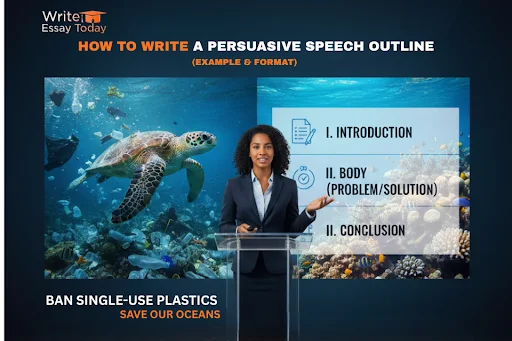
Public speaking is one of the most powerful skills you can develop, and persuasive speaking is its most influential form. Whether you’re convincing a classroom, a corporate team, or a community audience, a persuasive speech is designed to inspire belief, motivate action, or change minds.
But persuasion doesn’t happen by chance. It is the result of strategic structure, emotional connection, and logical reasoning. This is where a persuasive speech outline comes in, a detailed framework that helps you organize your ideas effectively and deliver them with impact.
In this guide, we’ll walk you through a step-by-step format for creating a persuasive speech outline, explore the key components, and conclude with a detailed example to help you craft your own powerful presentation.
What Is a Persuasive Speech?
A persuasive speech aims to influence the audience’s thoughts, attitudes, beliefs, or actions on a specific topic. Unlike informative speeches, which focus on delivering facts, persuasive speeches are argument-driven. They mix logic, emotion, and credibility to push for change.
For instance:
An informative speech might explain the effects of climate change.
A persuasive speech would urge the audience to adopt eco-friendly habits or support climate policy.
The core goal is not just to inform but to inspire.
Why Is a Persuasive Speech Outline Important?
A clear outline helps you:
- Organize your thoughts logically – avoiding rambling or confusion.
- Maintain audience attention – by progressing smoothly from one idea to another.
- Reinforce your message – by emphasizing key points with clarity and repetition.
- Boost confidence – knowing your structure helps reduce anxiety.
- Strengthen your argument – through balanced use of evidence and emotion.
A well-crafted outline serves as your blueprint, keeping you focused on your goal and ensuring every word leads your audience toward the desired outcome.
Step-by-Step Format for a Persuasive Speech Outline
Let’s break down each part of the persuasive speech structure, from the introduction to the conclusion.
1. Title
Choose a title that’s clear, compelling, and thought-provoking. It should immediately suggest your position.
Example Titles:
- Why Every City Should Ban Single-Use Plastics
- The Case for Universal Basic Income
- How Volunteering Can Change Your Life
2. General Purpose
The general purpose is to persuade, but you can refine it further depending on your audience.
There are three main persuasive goals:
- To Convince – changing beliefs or opinions.
- To Motivate – inspiring action.
- To Reinforce – strengthening existing attitudes.
3. Specific Purpose
This is a one-sentence statement that clearly defines what you want the audience to do or believe.
Example:
“To persuade my audience that recycling household waste should be mandatory in every city.”
This statement sets the tone for the rest of your outline.
4. Central Idea / Thesis Statement
Your thesis is the core argument — the takeaway you want your listeners to remember.
Example:
“Recycling is not just an individual choice but a social responsibility essential for environmental sustainability.”
The Persuasive Speech Outline Structure
I. Introduction
Your introduction should grab attention, establish credibility, and preview your main argument.
A. Attention Getter
Start strong with an engaging opening. You can use:
- A shocking statistic
- A rhetorical question
- A short story or anecdote
- A quote
- A bold statement
Example:
“Every minute, the equivalent of one garbage truck of plastic is dumped into our oceans. Imagine the world your grandchildren will inherit if we continue this way.”
B. Relevance to Audience
Explain why the topic matters to them.
“Whether you realize it or not, every piece of plastic you use contributes to this growing crisis.”
C. Credibility Statement
Show why you’re a reliable speaker on this topic.
“As a volunteer for coastal clean-up drives and a researcher on waste management, I’ve witnessed firsthand how small actions can lead to massive change.”
D. Thesis Statement
State your main argument.
“Plastic pollution is destroying marine life, damaging ecosystems, and threatening human health — and banning single-use plastics is the first step toward a cleaner planet.”
E. Preview of Main Points
Briefly mention what your main points will cover.
“Today, I’ll discuss the dangers of plastic waste, the benefits of banning single-use plastics, and practical ways cities can implement these policies.”
II. Body
The body is the heart of your speech. It presents your key arguments supported by logic, facts, and emotion.
You should organize it in one of these patterns:
- Problem–Solution Pattern – best for policy-based speeches.
- Cause–Effect Pattern – ideal when showing relationships between issues.
- Comparative Advantage Pattern – for contrasting ideas or solutions.
Here’s an example using the Problem–Solution–Action format.
A. Problem: The Dangers of Plastic Pollution
Explain the Problem
- Over 300 million tons of plastic are produced annually, and half is single-use.
- Oceans now contain over 150 million tons of plastic waste.
Illustrate the Consequences
- Marine animals ingest plastic, mistaking it for food.
- Plastic toxins enter the human food chain.
- Cleanup costs burden local governments and taxpayers.
Emotional Appeal (Pathos)
“Imagine a turtle suffocating on a plastic straw or a seabird dying with a stomach full of bottle caps. This is the real face of convenience culture.”
B. Solution: Banning Single-Use Plastics
Policy-Level Changes
- Governments can regulate plastic manufacturing.
- Encourage biodegradable alternatives like bamboo, paper, or glass.
Economic and Environmental Benefits
- Reduces landfill waste.
- Promotes sustainable industries.
- Saves marine life and protects tourism economies.
Use of Evidence (Logos)
“According to the United Nations, countries that banned single-use plastics saw a 40% reduction in waste within the first year.”
C. Action: What the Audience Can Do
Individual Responsibility
- Bring reusable bags, bottles, and containers.
- Support eco-friendly companies.
Community Action
- Petition local governments.
- Organize cleanup drives.
Emotional Appeal (Ethos + Pathos)
“Each of us has the power to shape a cleaner, safer world — one choice at a time.”
III. Counterarguments and Refutation
A strong persuasive speech anticipates objections.
A. Acknowledge Opposing Views
“Some argue that banning plastics will hurt small businesses or increase costs.”
B. Refute with Evidence
“However, studies from the EU show that transition costs decrease after initial adoption, and consumer support remains strong.”
IV. Conclusion
Your conclusion should reinforce your message and leave a lasting impression.
A. Restate Thesis
“Banning single-use plastics is not a burden; it’s a necessity for our planet’s survival.”
B. Review Main Points
“Today, we explored the dangers of plastic pollution, the benefits of policy change, and the actions we can all take.”
C. Memorable Closing Statement
“Let’s be the generation that says enough and turns the tide on plastic pollution once and for all.”
Key Techniques for Persuasive Speeches
To elevate your delivery, use these rhetorical strategies:
- Ethos (Credibility) – Build trust through authority, research, and sincerity.
- Pathos (Emotion) – Connect emotionally with personal stories, vivid imagery, or empathy.
- Logos (Logic) – Support arguments with data, studies, and factual reasoning.
- Kairos (Timing) – Show why your message matters now.
- Repetition and Parallelism – Reinforce your key points rhythmically.
Example: “We can reduce waste. We can protect the oceans. We can make change.”
Example of a Complete Persuasive Speech Outline
Title: “Ban Single-Use Plastics – Save Our Oceans”
General Purpose: To persuade
Specific Purpose: To convince my audience that banning single-use plastics is essential to environmental sustainability.
Thesis: Banning single-use plastics will protect marine life, reduce pollution, and promote a sustainable future.
I. Introduction
- Attention Getter: “Every minute, one garbage truck of plastic ends up in the ocean.”
- Relevance: “Plastic waste affects our health, economy, and planet.”
- Credibility: “As a volunteer in coastal cleanups, I’ve seen the damage firsthand.”
- Thesis: “Single-use plastics are poisoning our planet — it’s time to ban them.”
- Preview: “We’ll discuss the problem, the solution, and the actions we can take.”
II. Body
A. The Problem
- Plastic production has tripled since 1980.
- Over 1 million marine animals die annually due to plastic ingestion.
- Microplastics contaminate our food and water.
B. The Solution
- Implement government bans on single-use plastics.
- Invest in biodegradable alternatives.
- Educate the public on sustainable practices.
C. The Action
- Stop using plastic straws, bags, and bottles.
- Support local zero-waste initiatives.
- Advocate for environmental policy reform.
III. Refutation
- Opposing View: “Plastic bans hurt business.”
- Rebuttal: “Many companies adapt quickly, finding cost-effective green solutions.”
IV. Conclusion
- Restate Thesis: “Banning single-use plastics protects our future.”
- Call to Action: “Let’s act today to ensure a cleaner tomorrow.”
- Closing Line: “Our oceans can’t speak — but through our choices, they can breathe again.”
Tips for Delivering a Persuasive Speech
Now that you know how to structure your speech, let’s focus on how to deliver it with confidence and impact.
- Know Your Audience – Understand their beliefs, fears, and motivations.
- Use Evidence Wisely – Support claims with credible sources.
- Engage with Stories – Personal examples make your message relatable.
- Use Visuals – Slides or props can enhance retention.
- Practice Vocal Variety – Tone and pauses add emotion and power.
- Maintain Eye Contact – Builds connection and confidence.
- End Strong – Leave your audience inspired and ready to act.
To make your persuasive speech more impactful, it’s essential to choose the right tone for your audience. Learn how to do this in our guide on Types of Tones in Writing and When to Use Them.
Common Mistakes to Avoid
Before you step on stage, it’s important to know what can weaken your message or distract your audience.
- Overloading with facts – Use data strategically, not excessively.
- Ignoring counterarguments – Address opposing views respectfully.
- Lack of clarity – Keep your message focused and concise.
- Weak conclusion – Always end with a memorable and motivational statement.
To explore more about structuring and delivering your speech with confidence, read our comprehensive article How To Write A Perfect Persuasive Speech – Steps + Tips.
WriteEssayToday Helps You Speak with Purpose
A persuasive speech isn’t about manipulation; it’s about meaningful influence. It’s your opportunity to make others see what you see and feel what you feel.
When structured properly, your speech becomes more than just words; it becomes a movement in itself.
Every great speech starts with a single idea and the courage to share it. Let WriteEssayToday’s Affordable Writing Service help you turn that idea into a speech that informs, inspires, and moves your audience to action.
And if you are looking to refine your writing skills even further or need professional help with other academic projects, our cheap case study writing service offers affordable, high-quality support to help you communicate your ideas with confidence and precision.