

In research, business strategy, product development, and even quality management, two approaches frequently appear: case studies and experiments. Both are powerful tools for generating insights, validating ideas, and guiding decisions. However, they serve fundamentally different purposes and operate under different assumptions.
Yet, many professionals confuse the two or use them interchangeably. This often leads to flawed conclusions, weak decision-making, or misaligned research strategies.
Understanding the difference is not just academic. It directly impacts:
- How you gather data
- How reliable your conclusions are
- How confident you can be in decision-making
In this comprehensive guide, we will break down what case studies and experiments are, how they differ, when to use each, and how to combine them effectively for maximum impact.
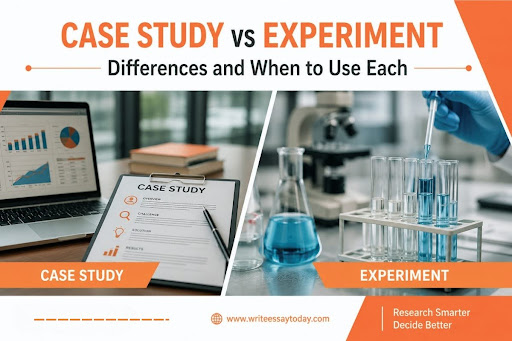
What Is a Case Study?
A case study is an in-depth analysis of a specific subject within its real-world context. This subject could be:
- A company
- A project
- A product launch
- A failure or success scenario
- A specific event or process
Key Characteristics of a Case Study
- Focuses on real-world situations
- Explores complex, contextual factors
- Often uses qualitative data (interviews, observations, documents)
- Provides detailed insights rather than generalizable conclusions
Example
A company analyzes why a specific supplier failed during production. The study includes:
- Timeline of events
- Communication breakdowns
- Quality control gaps
- Operational challenges
This is a case study because it examines a real situation in depth.
What Is an Experiment?
An experiment is a structured method used to test a hypothesis by controlling variables and observing outcomes.
Key Characteristics of an Experiment
- Conducted in a controlled environment
- Focuses on cause-and-effect relationships
- Uses quantitative data
- Involves independent and dependent variables
Example
A company tests two packaging materials:
- Material A vs Material B
- Same conditions (temperature, handling, shipping)
- Measures damage rates
This is an experiment because variables are controlled to isolate outcomes.
Core Difference Between Case Study and Experiment
At its core, the difference lies in exploration versus validation.
A case study is used to deeply understand a real-world situation. It examines what happened, why it happened, and how different factors interacted within a complex, uncontrolled environment. It is about uncovering insights from reality.
An experiment, in contrast, is designed to test a specific assumption. It isolates variables within a controlled setting to determine clear cause-and-effect relationships. It is about proving what works and what does not.
In simple terms, a case study helps you understand reality in depth, while an experiment helps you test and confirm decisions with precision.
Key Differences Between Case Study and Experiment
While both methods aim to generate insights, they differ fundamentally in how they approach problems and the type of results they produce. Understanding these differences helps you choose the right method for the right situation.
1. Purpose
A case study is used to explore and understand complexity within a real-world context. It focuses on uncovering insights, patterns, and underlying reasons behind a situation.
An experiment is designed to test specific hypotheses and establish clear cause-and-effect relationships through controlled testing.
2. Environment
A case study operates in a real-world setting where variables are not controlled, allowing for a more natural and contextual understanding.
An experiment takes place in a controlled environment where variables are carefully managed to isolate their impact.
3. Data Type
A case study primarily relies on qualitative data such as observations, interviews, and documents, though it can include some quantitative elements.
An experiment relies on quantitative data, focusing on measurable outcomes and statistical analysis.
4. Outcome
A case study delivers detailed insights, explanations, and patterns that help interpret complex situations.
An experiment produces measurable, repeatable results that can confirm or reject a hypothesis.
5. Generalization
A case study offers limited generalizability since it is based on specific contexts and scenarios.
An experiment, when properly designed, allows for broader generalization and application of results across similar conditions.
In essence, case studies help you understand what is happening, while experiments help you prove what works.
When to Use a Case Study
Case studies are most effective when the goal is not just to find an answer, but to fully understand a situation in its real-world context. They are particularly valuable when problems are layered, dynamic, and influenced by multiple interacting factors.
When a Case Study Is the Right Choice
A case study is the best approach when:
- The problem is complex and shaped by real-world conditions rather than isolated variables
- You need a deep, contextual understanding instead of quick or surface-level answers
- Variables cannot be easily controlled or separated for testing
- Real-world behavior, processes, and interactions matter more than theoretical models
- You are trying to understand why something happened, not just measure what happened
Common Use Cases
Case studies are widely used across industries where context and detail are critical:
- Business strategy analysis to understand successes or failures
- Failure investigations to identify root causes and process breakdowns
- Supplier performance reviews to evaluate consistency and reliability
- Product launch evaluations to assess market response and execution gaps
- Organizational behavior studies to understand internal dynamics and decision-making
Advantages of Case Studies
- Provide rich, detailed insights that go beyond surface-level data
- Reflect real-world conditions, making findings practical and relevant
- Capture nuance, complexity, and human factors that structured methods often miss
- Help generate hypotheses for further testing
Limitations of Case Studies
- Limited scalability, as findings are often specific to one context
- Potential for bias due to subjective interpretation or incomplete data
- Difficult to replicate, making it harder to validate results across different scenarios
In essence, a case study is most valuable when understanding the full story matters more than isolating a single variable.
When to Use an Experiment
Experiments are most valuable when your goal is not just to understand a situation, but to prove what works with measurable certainty. They are designed to eliminate guesswork by isolating variables and testing outcomes under controlled conditions.
When an Experiment Is the Right Choice
An experiment is the best approach when:
- You need to test a specific hypothesis or assumption
- Key variables can be isolated and controlled effectively
- You want to establish clear cause-and-effect relationships
- Decisions must be backed by measurable, data-driven evidence
- You are comparing alternatives to determine the most effective option
Common Use Cases
Experiments are widely used in scenarios where precision and validation are critical:
- A/B testing in marketing to compare campaigns, creatives, or user experiences
- Product performance testing to evaluate durability, efficiency, or usability
- Quality control validation to ensure materials or processes meet standards
- Process optimization to identify improvements in efficiency or output
Advantages of Experiments
- Provide high reliability through controlled testing conditions
- Deliver clear, objective conclusions based on measurable data
- Enable repeatability, allowing results to be verified and scaled
- Reduce uncertainty by isolating the exact factors that drive outcomes
Limitations of Experiments
- May oversimplify real-world conditions by removing contextual variables
- Require controlled environments, which may not always be practical
- Can be resource-intensive in terms of time, cost, and setup
In essence, experiments are most effective when you need to move from assumption to certainty and make decisions based on proven results rather than observation alone.
Real-World Examples
Example 1: E-Commerce Conversion
Case Study: Analyze why a website redesign failed
Experiment: A/B test two versions of a checkout page
Example 2: Manufacturing Quality
Case Study: Investigate why a batch failed inspection
Experiment: Test different materials under identical conditions
Example 3: Marketing Campaign
Case Study: Review performance of a past campaign
Experiment: Test two ad creatives to measure engagement
Can You Use Case Studies and Experiments Together?
The strongest outcomes rarely come from using just one method. High performing organizations combine case studies and experiments to move from insight to validation in a structured way.
A case study helps you understand what is happening in the real world, while an experiment helps you test whether your assumptions are correct. Together, they create a complete decision making framework.
How the Combined Approach Works
Start with a case study
Analyze real-world situations to identify patterns, issues, and possible causes. This stage is about exploration and understanding.
Form clear hypotheses
Based on your findings, define specific assumptions that can be tested.
Follow with an experiment
Test those hypotheses under controlled conditions to determine cause and effect.
Use results to guide action
Apply validated insights to improve processes, products, or strategies with confidence.
Example Workflow
- A case study reveals recurring defects in production
- Initial analysis suggests material inconsistency as a possible cause
- A hypothesis is formed: material variation is driving defect rates
- An experiment is conducted by testing different materials under identical conditions
- Results confirm or reject the hypothesis, enabling informed decision making
Why This Combination Works
- Case studies provide depth, context, and real-world understanding
- Experiments provide clarity, validation, and measurable proof
- Together, they reduce uncertainty and improve decision accuracy
This integrated approach ensures that decisions are not based on assumptions alone, but are supported by both real-world insight and tested evidence.
Common Mistakes to Avoid
Even when using the right methods, misapplication can lead to weak insights and poor decisions. Understanding where things go wrong helps you use both case studies and experiments more effectively.
1. Treating Case Studies as Proof
A case study provides deep insight into a specific situation, but it does not establish universal truth. Drawing broad conclusions from a single scenario can lead to flawed strategies. Use case studies to generate understanding and hypotheses, not to prove them.
2. Over-Relying on Experiments
Experiments are powerful for validation, but they often simplify reality. Controlled environments remove many variables that exist in real-world conditions. Relying solely on experimental results can lead to decisions that do not perform as expected in practice.
3. Ignoring Real-World Context
Even well-designed experiments must be interpreted within context. Factors such as human behavior, environmental conditions, and operational constraints can influence outcomes. Failing to account for these can reduce the effectiveness of your decisions.
4. Using the Wrong Method for the Problem
Choosing the wrong approach weakens results from the start. Using an experiment when the problem requires deep contextual understanding, or relying on a case study when you need clear causation, leads to incomplete or misleading conclusions.
The key is not just using case studies or experiments, but applying the right method at the right time, and understanding the limitations of each.
Decision Framework: Which One Should You Use?
Ask yourself:
- Do I need to understand a real-world situation deeply? → Use a case study
- Do I need to test a specific variable or hypothesis? → Use an experiment
- Do I need both insight and validation? → Use both together
For a more practical approach to structuring real world insights, you can also read our guide on How to Write an Interview Essay: A Step by Step Guide, which shows how to turn interviews into clear, engaging, and well organized academic writing.
Why This Matters in Business and Industry
The choice between a case study and an experiment is not just a methodological decision. It directly impacts how effectively a business understands problems, tests solutions, and executes strategies.
Across key areas such as:
- Supply chain management
- Quality control
- Product development
- Marketing and customer experience
The method you choose influences the quality of your decisions and the outcomes that follow.
What Is at Stake
Using the right approach leads to:
- More accurate decision making based on the right type of insight
- Stronger risk management by identifying issues early and validating solutions
- Greater operational efficiency through data-driven improvements
Using the wrong approach, however, can result in incomplete understanding, misinformed actions, and costly inefficiencies.
How It Works in Practice
- A case study might uncover recurring supplier issues, process gaps, or customer behavior patterns by analyzing real-world situations
- An experiment then tests potential solutions, such as process changes or alternative materials, to determine what actually works
Individually, each method provides value. Together, they form a complete decision-making system that combines insight with validation.
In business, the goal is not just to understand problems or test solutions in isolation, but to connect both. That is what drives consistent, scalable results.
To strengthen your academic writing further, you can also explore our guide on How to Write an Article Review: Structure, Tips, and Examples, which breaks down how to critically analyze and present research effectively.
Elevate Your Academic Writing with WriteEssayToday
Case studies and experiments are not competing methods, they are complementary tools.
- Case studies help you understand reality
- Experiments help you test and validate decisions
Relying on only one limits your perspective. Combining both gives you a balanced approach that is both insightful and reliable.
Understanding the difference between case studies and experiments is about choosing the right approach to produce meaningful, reliable work.
A strong essay, research paper, or project is built on clarity of method. When you know whether to explore a topic through real-world analysis or test it through structured validation, your arguments become stronger, your conclusions more credible, and your work more impactful.
At WriteEssayToday, academic writing is approached with clarity, structure, and purpose. With the support of expert Case Study Writers, each assignment is carefully developed to reflect strong reasoning, logical flow, and a clear understanding of the topic. From in-depth case studies to well-structured experimental analysis, the focus remains on delivering work that is both insightful and academically reliable.
Great writing is not just about presenting ideas, it is about presenting them in a way that is clear, persuasive, and logically connected. That is the standard WriteEssayToday is built on, helping you produce work that is refined, credible, and confidently presented.