

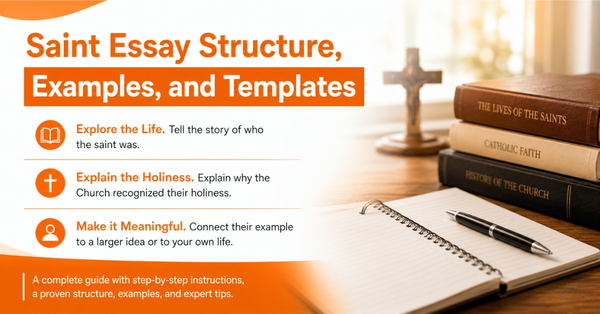
A saint essay is a piece of writing that explores the life, virtues, and lasting influence of a canonized saint. Most saint essays ask you to do three things. Tell the story of who the saint was. Explain why the Church recognized their holiness. Connect their example to a larger idea or to your own life. That is the whole job. Everything below shows you how to do each part well.
A saint essay is not limited to one type of assignment. It could be part of a Confirmation project, a religion or history class, or even a college application where you reflect on the values a saint inspires in you. Although each assignment has a different purpose, they all rely on the same foundation: thoughtful research, clear organization, and meaningful analysis.
This guide shows you exactly how to write a saint essay, step by step, a proven structure, a worked example, and expert answers to common questions.
The Three Kinds of Saint Essay
The first step isn't writing your introduction. It's identifying the type of saint essay you've been assigned. Although the title may sound straightforward, these assignments vary widely in purpose and expectations. Knowing whether your focus should be biography, analysis, or personal reflection can make the difference between an average grade and an excellent one.
Confirmation Saint Essay
The Confirmation saint essay is personal and devotional. Its goal is to explain why you chose this saint as your patron, so it emphasizes virtues, your reasons, and your faith journey.
Academic Saint Report
The academic saint report is formal and neutral. Its goal is to present a factual, sourced biography, so it emphasizes dates, historical context, and evidence.
Reflection or Application Essay
The reflection or application essay is reflective and personal. Its goal is to use the saint to illuminate a value or theme, so it emphasizes one clear idea and your own growth.
Quick check: read the prompt and underline every verb. Words like "describe" and "report" point to the academic type. Words like "explain why you chose" or "reflect on" point to the personal and devotional type. The verbs tell you what your teacher will grade.
How to Choose a Saint Worth Writing About
The best saint essays start with a good match. A saint you find genuinely interesting is far easier to write about with detail and energy than one picked at random from a list. If your assignment lets you choose, spend a few minutes here. It pays off in every paragraph that follows.
Use a simple matching approach. Start from something true about you, then find a saint who shares it. There is a patron for almost everything, so the connections are easier to find than you might think.
- Match a cause or interest. Care about animals, the poor, the sick, students, musicians, or travelers. Each has a recognized patron.
- Match a profession or goal. Doctors, teachers, writers, soldiers, and lawyers all have patrons whose lives speak to that work.
- Match a personal quality. Courage, patience, conversion, or perseverance each shines in the story of a specific saint.
- Match your background. A saint from your country, culture, or family tradition gives your essay a natural personal thread.
One more rule of thumb. Pick a saint with enough recorded life to fill your word count. Some saints have detailed histories and their own writings. Others survive mostly as legend, which leaves you little solid material. For a research assignment, choose the well documented figure. For a devotional piece, a beloved but lightly documented saint can still work because your reflection carries the weight.
Where to Find Reliable Facts
Saints inspire legends, but legends are not always history. That is part of their appeal and one of the biggest research pitfalls. Many popular websites repeat stories that have never been verified, and citing unreliable claims can undermine the credibility of your entire essay. Build your research on trustworthy academic and primary sources, and always cross check surprising or extraordinary claims before including them.
- Primary and official sources. Vatican biographies, canonization documents, and the saint's own letters or writings where they exist.
- Scholarly references. Established Catholic encyclopedias and peer reviewed religious studies databases from universities.
- Reputable published biographies. Well reviewed hagiographies and histories, used with an eye for which claims are documented and which are tradition.
- General websites, with caution. Useful for a first orientation only. Confirm every date and fact against a source from the tiers above.
Trust rule: confirm every date and major fact in at least two independent sources. If a claim only appears on one popular site and nowhere reliable, treat it as legend and label it that way in your essay.
The Structure That Works Every Time
A saint essay follows the same shape as most academic essays, with content chosen to fit a life story. Use this five part frame and adjust the number of body paragraphs to match your length. Short assignment, three paragraphs. Longer paper, expand each middle section.
- Introduction: One vivid detail, the saint's name and dates, and a thesis that states your main idea.
- Early life and calling: Where and when they lived, their background, and the turning point that set their path.
- Works and defining virtues: What they did, the qualities they are known for, and the miracles or writings tied to them.
- Death and legacy: How their life ended, their canonization, their patronage, and their influence today.
- Conclusion: Restate the main idea in fresh words and land a final thought that sticks.
How to Write an Introduction That Hooks Your Reader
Skip the slow windup. Do not open with "Throughout history, many holy people have lived." That sentence says nothing and wastes your reader's attention. Open instead with one specific, surprising, or human detail from the saint's life, then move fast to your thesis.
Think of the introduction as a short bridge. The hook draws the reader in. The bridge connects that detail to the bigger picture. The thesis states the claim your essay will prove. Three moves, no filler. If you want a deeper set of openers to work from, our guide to good hooks for essays breaks down the types that land best.
Hook to thesis bridge:
- Hook: a single striking fact or moment from the saint's life.
- Bridge: one sentence linking that moment to who the saint became.
- Thesis: the main idea your essay will prove about this saint.
Your thesis is the spine of the essay. It should make a claim, not just announce a topic. "This essay is about Saint Francis" is a topic. "Saint Francis showed that radical simplicity could reshape a wealthy and divided church" is a thesis. The second one gives every body paragraph a job to do. For a full walkthrough of turning a topic into a claim, see our complete guide on how to write a thesis.
Fill in the blank thesis starters:
- Through [key act or virtue], Saint [name] showed that [larger idea].
- I chose Saint [name] as my patron because [reason], and their example calls me to [goal].
- The life of Saint [name] reveals how [quality] can [effect on others or the world].
Building Strong Body Paragraphs
Each body paragraph should carry one idea and support it with evidence. Lead with a topic sentence, give the facts, then explain what those facts mean. That last step is where most saint essays fall short. Students narrate life but forget to interpret it. Always tell the reader why a fact matters.
Move through life in a logical order. A time based order works well for a full biography. A theme based order works well for a reflection, where you group the essay around two or three virtues rather than a strict timeline. Here is what each section usually needs to include.
- Early life. The place, the time period, the family, and the world the saint was born into. Set the scene so later choices make sense.
- The calling or conversion. The moment or process that turned an ordinary person toward holiness. This is often the heart of the story.
- Works and service. What the saint actually did. Founded an order, cared for the sick, wrote, taught, preached, or led. Be specific.
- Miracles and writings. The signs, healings, or works attributed to them, presented in a way that fits your essay type.
- Death and canonization. How their life ended, whether they died a martyr, and how and when the Church declared them a saint.
Transitions matter more than students think. Each paragraph should hand off to the next so life reads as one story, not a stack of separate facts. A short linking phrase does the work. Show how the calling led to the works, how the works drew both followers and opposition, and how that opposition shaped the ending. When the reader can follow the thread from one paragraph to the next, the essay feels alive.
Evidence tip: use short, specific facts as proof. A single dated event or a real quotation from the saint carries more weight than three sentences of general praise. Show the reader the holiness. Do not just assert it.
Handling Miracles and Faith Claims
This is where saint essays get tricky, and it is where many guides stay silent. Miracles are central to canonization, so you will almost always need to mention them. How you present them depends entirely on your essay type, and matching the tone to the assignment is what separates a polished essay from an awkward one.
In a devotional or Confirmation essay, you can write about miracles as acts of faith. You are inside a faith tradition, speaking to it, and treating a miracle as real is appropriate. In an academic essay, keep a small but important distance. Present miracles as claims recorded by the Church rather than as proven historical events. A phrase like "according to tradition" or "the Church credits the saint with" lets you report the account accurately without overstepping what history can prove.
Tone match. Devotional voice: "Through her prayers, the sick were healed." Academic voice: "Tradition holds that healings followed her prayers, and these accounts supported her canonization." Same fact. Different frame. Choose the one your assignment expects.
Landing the Conclusion
A weak conclusion just repeats the introduction. A strong one leaves the reader with something to carry away. Restate your main idea in fresh words, draw the threads of the essay together, and end on a single resonant thought. For a personal essay, this is the place to name what the saint asks of you. For an academic essay, this is the place to state the saint's lasting significance.
Do not introduce brand new facts in the conclusion. If a detail is important enough to include, it belongs in a body paragraph where you can support it. The ending is for meaning, not for leftover information.
A useful trick is to echo your hook. If you opened with a single striking image or moment, return to it at the close with fresh understanding. The reader feels the essay come full circle, and the saint's story feels complete rather than simply stopped. Read your last line out loud. If it sounds like a real ending, you are done. If it sounds like you ran out of room, write one more sentence that says what the whole essay was really about.
A Worked Mini Example
Here is how the pieces fit together in a short outline for an essay on Saint Teresa of Ávila. Notice how the hook is specific, the thesis makes a claim, and each body point has a clear job.
- Hook. At forty, a Spanish nun who had spent years restless and half hearted in prayer had a conversion so complete it reshaped an entire religious order.
- Thesis. Saint Teresa of Ávila showed that deep interior prayer and practical reform were not opposites but partners, and that one person's honesty about her own weakness could renew a whole tradition.
- Body 1. Early life in sixteenth century Spain and her entry into the convent, setting up the comfortable but shallow faith she later broke from.
- Body 2. Her conversion and her writings on prayer, including works still read today, presented as her defining contribution.
- Body 3. Her reform of the Carmelite order and the resistance she faced, shown as proof that her inner life produced outer change.
- Conclusion. Her legacy as a Doctor of the Church and what her blend of prayer and action still offers readers now.
Common Mistakes to Avoid
Even well researched essays can lose marks because of avoidable mistakes. Watch for these common errors before you submit your work.
- Retelling without interpreting. A list of events is a summary, not an essay. Always explain what the facts mean.
- Mixing legend with fact. Present unverified stories as tradition, not as history, especially in academic work.
- Ignoring the prompt type. A devotional reflection graded as an academic report will lose points no matter how well written.
- A vague thesis. If your main idea could apply to any saint, it is too broad. Make it specific to this one.
- A padded introduction. Cut anything before the first real detail. Start where the story starts.
- Weak sourcing. One popular website is not enough. Cross check and cite reliable sources.
Frequently Asked Questions
How long should a saint essay be?
Most saint essays run between 500 and 1,000 words. Younger students may write two to four paragraphs, while high school and college assignments usually expect a full five paragraph structure or more. Always follow the word count your teacher sets. When no length is given, aim for the five part structure so you have room to cover the saint's life, works, and legacy.
How do I start a saint essay?
Start with a single vivid fact or moment from the saint's life, then move quickly to a thesis that states why the saint matters. Avoid long historical windups. Name the saint, give one striking detail, and tell the reader the main idea your essay will prove.
What should a Confirmation saint essay include?
A Confirmation saint essay should explain who the saint was, why you chose them, and how their example connects to the person of faith you want to become. Include a short biography, one or two defining virtues, and a personal reflection linking the saint to your Confirmation.
Where can I find reliable information about saints?
Use trusted sources such as official Vatican biographies, established Catholic encyclopedias, university religious studies databases, and reputable published hagiographies. Cross check dates and facts across at least two sources, since popular websites often repeat legends as fact.
Do I need to include miracles in a saint essay?
Miracles are usually worth mentioning because they are central to canonization, but how you present them depends on the assignment. In a devotional or Confirmation essay you can write about them as acts of faith. In an academic essay, present them as claims recorded by the Church rather than as proven events.
How do I choose a saint to write about?
Choose a saint whose life connects to something you care about, such as a cause, a profession, a country, or a personal quality. A saint you find interesting is far easier to write about with energy and detail than one picked at random.
Let Write Essay Today Handle It For You
The deadline may be fixed, but the quality of your essay doesn't have to suffer. Hand it to a professional academic writer who researches the sources, matches your assigned tone, and delivers an original essay ready to submit. No templates, no filler, no missed due date.